
Bob Richards Release Path
The Gordon County jail overview states that juveniles are not held at the adult jail. Youth may instead be transferred to juvenile detention in Rome or Dalton. The Georgia DJJ RYDC directory lists Bob Richards Regional Youth Detention Center in Rome and identifies Gordon among the counties it serves. That makes Bob Richards a possible youth custody destination, not a branch of the Gordon County Jail.
A youth may return to a parent or guardian, move under a juvenile-court order, or enter another authorized placement. The research does not support a public list of those outcomes. It also does not support a promise that a call by any member of the public will produce a custody status. The sound path is to identify the juvenile case, contact the lawyer or juvenile court handling it, and use DJJ contacts available to a person entitled to the information.
Confirm Bob Richards Release
Start with relationship and authority. Juvenile confidentiality may control whether staff can confirm a youth's presence, release, destination, or case details. A parent, guardian, lawyer, or other authorized participant should have the youth's full name, date of birth, juvenile case information if known, and the referring county ready. Gordon County is the key referral fact because Bob Richards serves more than one area.
- Confirm that the matter is juvenile. Do not search the adult Gordon County roster and infer a release from no result.
- Check the DJJ facility directory to verify the correct center and current agency listing.
- Contact the youth's lawyer or the juvenile court connected to the Gordon County case for the controlling order and permitted case information.
- Use the DJJ or facility contact made available to the authorized party. Ask about the proper status-confirmation process, not unrestricted public records.
- If the youth moved to another placement, follow the court or DJJ direction rather than treating the move as release to the community.
This process protects both accuracy and confidentiality. A transfer is a change of custody or placement. It is not proof that supervision ended. A court order is the best source for the legal basis of release, continued detention, or placement, but access to that order may also be restricted.
Bob Richards Record Access
Adult booking records in Gordon County can sometimes be requested under the Georgia Open Records Act. Juvenile records require a different analysis. The Gordon research expressly warns that juvenile release records may be confidential. That means the adult workflow of requesting a public booking sheet, release timestamp, and booking photo should not be copied onto a Bob Richards request.
An authorized requester should ask the responsible office what proof of identity and relationship is required and which part of the record may lawfully be disclosed. Keep the request narrow: custody-status confirmation, the date of a permitted release notice, or a copy of an order the requester has a right to receive. Staff may refuse to discuss the case with someone who cannot establish access. That refusal does not show whether the youth is or is not at Bob Richards.
- Release
- An authorized end to detention or a move directed by the juvenile process; it does not always mean the youth has no ongoing conditions.
- Transfer
- A move from one custodian or placement to another.
- Confidential
- Information whose disclosure is limited by law or court rule, even when an adult record of a similar event might be public.
- Disposition
- The juvenile court's resolution or order in the case.
Bob Richards Facility Role
Bob Richards is a regional youth detention center operated by the Georgia Department of Juvenile Justice. Its address is 200 Marable Way, Rome, Georgia 30165-1387. It is outside Gordon County but serves Gordon County youth. The adult jail's statement about transfers to Rome supplies the local link; the DJJ directory supplies the named facility and service area.
The facility should not be described as an adult county jail, a state prison run by GDC, or a local released-inmate search portal. GDC's adult offender query tracks state adult corrections cases. Gordon County Offender Index tracks the local adult jail. Neither is the correct source for a youth held through DJJ.
Bob Richards Regional Youth Detention Center200 Marable Way
Rome, GA 30165-1387
Operator: Georgia Department of Juvenile Justice
Confirm current contact through the DJJ facility directory.
Using the directory also avoids relying on stale phone details that the research did not establish. The Gordon County release connection is based on referral and service, not on the facility being physically located in Gordon County.
Gordon Youth Roster Absence
A common source of confusion is a search for a young person on Gordon County Offender Index. That roster displays adult county-jail custody and recent booking data. Gordon County says juveniles are not housed at its jail. A blank adult result therefore cannot establish that a youth was never detained, has been released, or is now at Bob Richards.
| Question | Correct route |
|---|---|
| Is an adult still at Gordon County Jail? | Offender Index and jail confirmation |
| Is a Gordon County youth in DJJ custody? | Authorized DJJ and juvenile-court channels |
| Did the juvenile court order release or placement? | Juvenile court or lawyer, subject to access limits |
| Was an adult transferred to state prison? | GDC offender query |
Keeping the systems separate prevents a false conclusion. The Gordon County release overview covers adult paths, while this facility page marks the point where the adult public-record approach stops.
Bob Richards Directory Evidence
The official Georgia DJJ locations page provides the statewide facility-navigation context shown below.
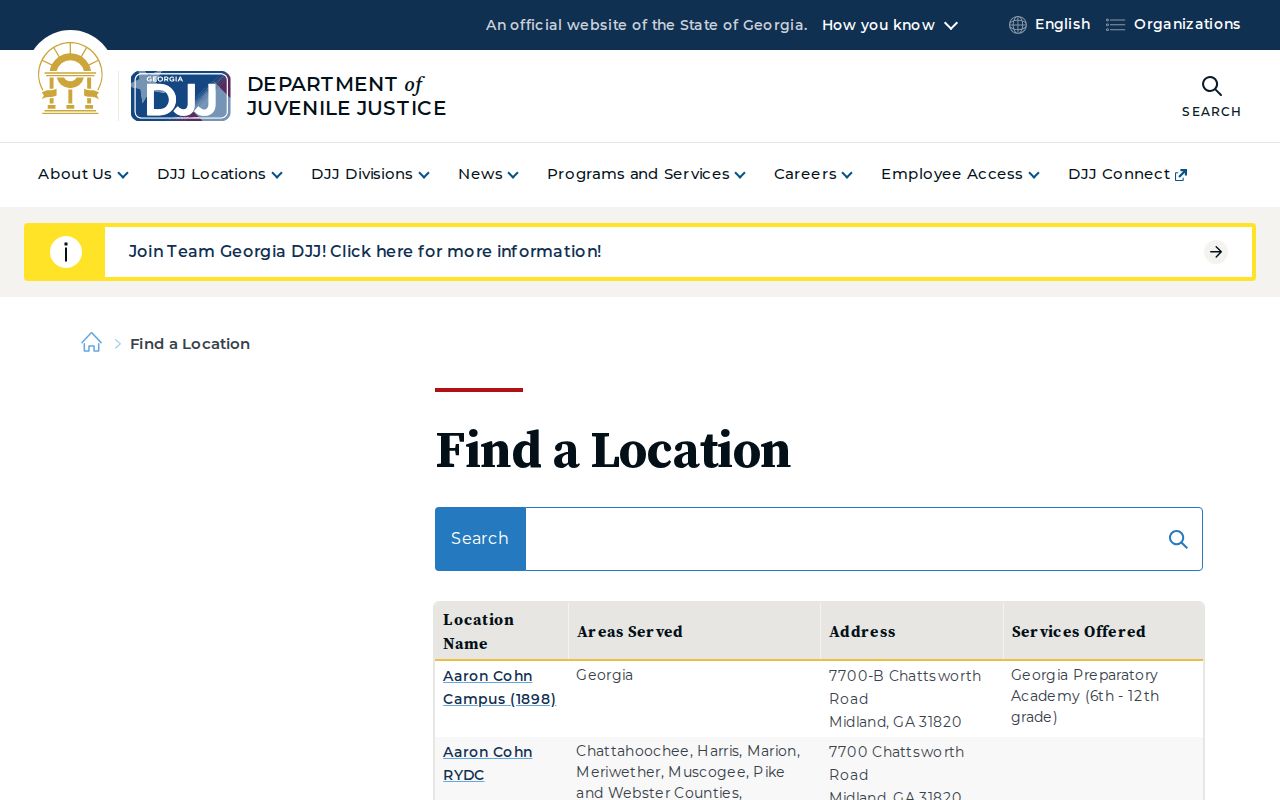
The image supports the DJJ routing step. It does not display a youth roster, a release list, or case information, and it should not be read as one.
Bob Richards Custody Changes
Terms matter when asking about a youth. “Released” may be used loosely for a move out of secure detention, but the next step can remain governed by a juvenile-court order. A placement change, transfer, or return to a guardian may carry conditions that are not visible to the public. Ask the authorized office to state the exact event it can disclose.
VINE is a custody-notification tool used in many adult cases. The Gordon research does not establish it as a public Bob Richards youth-release source. Do not register through an adult service and assume that no match proves no juvenile custody. Likewise, the 24-hour and 72-hour Gordon County pages discuss adult bookings, not DJJ releases.
Gordon Youth ICE Distinction
Research Section 19 notes that immigration inquiries or detainers can complicate some local adult custody events. Nothing in the cited Gordon County report establishes Bob Richards as an ICE facility. The ICE detainee locator is a civil immigration channel and must not be presented as a routine youth detention lookup. If a juvenile case presents an immigration issue, the authorized lawyer and responsible agencies are the proper route.
This distinction follows the same core rule: a move between systems is not the same as release to the community. Confirm the legal custodian and the controlling court process before drawing a conclusion.